
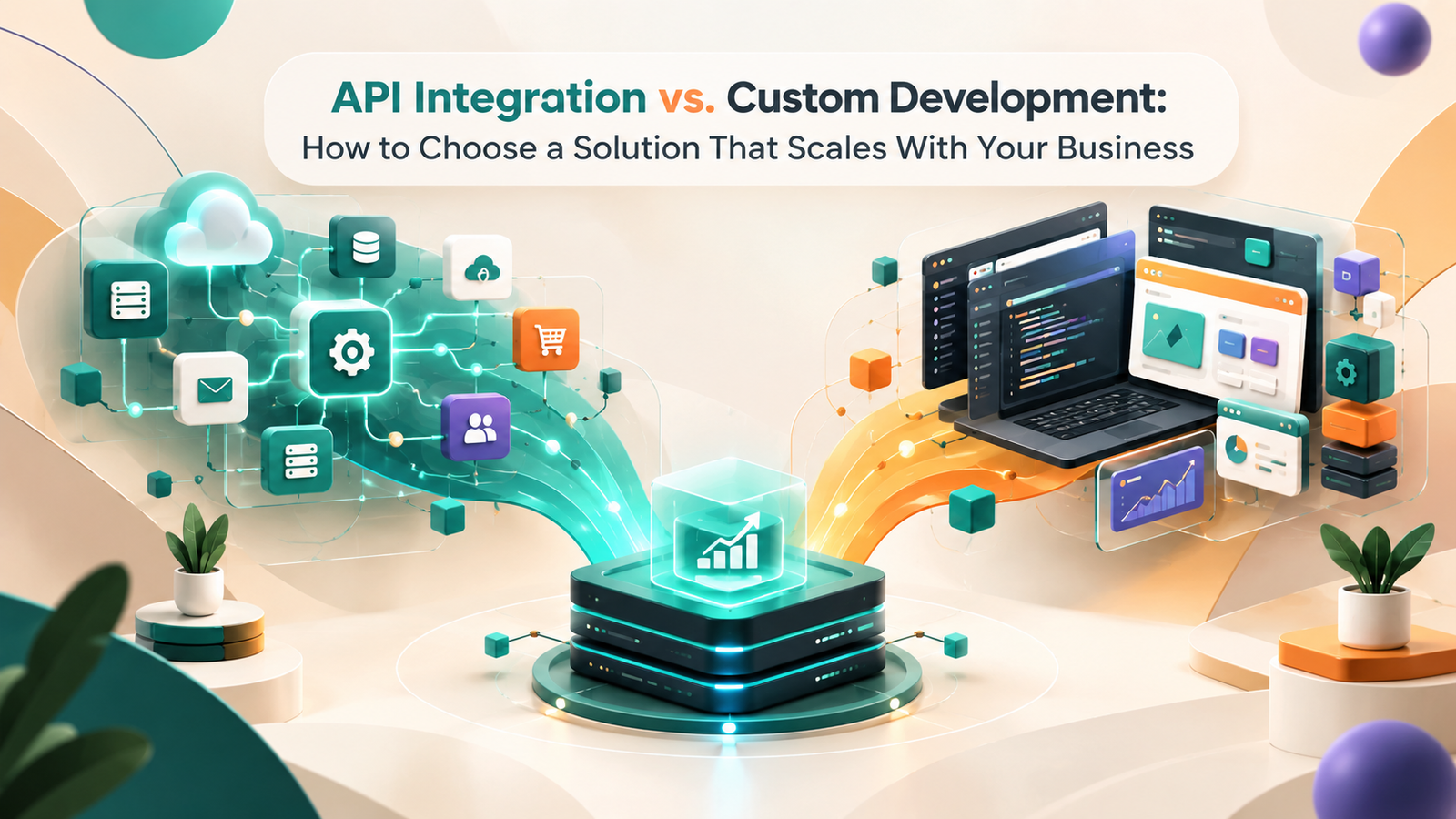
Businesses today rely heavily on technology to manage operations, connect with customers, automate workflows, and support long-term growth. As companies expand, they often face an important technology decision: should they connect existing software through APIs or invest in custom-built software?
Understanding API Integration vs. Custom Development can help businesses select a solution that matches their current requirements while also preparing them for future growth. Both approaches can improve efficiency and digital capabilities, but they serve different purposes and come with their own advantages.
Understanding API Integration
API integration is the process of connecting two or more software applications so they can communicate and exchange information. An API, or Application Programming Interface, provides a structured way for different systems to share data and functionality.
For example, an e-commerce business may connect its website with payment gateways, inventory management software, customer relationship management systems, shipping platforms, and analytics tools. Instead of building every feature from scratch, APIs allow these existing systems to work together.
How API Integration Works
An API acts as a communication layer between applications. When one application requests specific information or functionality, the API processes the request and returns the appropriate response.
For businesses, this can create a connected technology ecosystem without requiring an entirely new software platform.
Common API integration examples include:
- Payment gateway integration
- CRM integration
- Cloud service integration
- Accounting software integration
- Social media integration
- Shipping and logistics integration
- Marketing automation integration
- AI and machine learning service integration
- Business analytics integration
Benefits of API Integration
API integration can help businesses reduce development effort while improving connectivity between their existing systems.
One major advantage is speed. If a reliable API already exists for a required service, developers can integrate it rather than recreating the functionality from the ground up.
API integration can also improve automation. Data can move automatically between platforms, reducing repetitive manual tasks and minimizing data-entry errors.
Another benefit is flexibility. Businesses can combine specialized tools from different providers to create a technology ecosystem that supports specific operational requirements.
Understanding Custom Development
Custom development involves creating software specifically for a business, its users, and its workflows. Instead of adapting existing software to meet business requirements, developers build functionality around those requirements.
Custom development may be appropriate when a business has unique processes that cannot be effectively handled by off-the-shelf products or available APIs.
For example, a logistics company may require a specialized platform for route management, delivery tracking, driver operations, and customer communication. If existing solutions cannot provide the required combination of features, custom software may offer a more suitable approach.
How Custom Development Works
Custom development generally begins with business and technical requirements. Developers analyze the company’s goals, users, workflows, security requirements, and future plans.
The software is then designed and developed according to those specifications.
A custom solution may include:
- Custom dashboards
- Business-specific workflows
- Specialized databases
- Custom customer portals
- Internal management systems
- Automated business processes
- Advanced reporting
- AI-powered functionality
- Custom mobile or web applications
Benefits of Custom Development
The biggest advantage of custom development is control. Businesses can decide how their software should operate instead of adjusting their processes around an existing product.
Custom software can also provide greater flexibility when requirements are highly specific.
Another advantage is scalability. Developers can design the architecture with future requirements in mind, allowing the platform to evolve as the organization grows.
API Integration vs. Custom Development: Key Differences
When evaluating API Integration vs. Custom Development, businesses should look beyond the initial development process. Factors such as cost, scalability, flexibility, maintenance, security, and project requirements all matter.
Development Time
API integration can often be completed faster when suitable APIs are already available and well documented. Developers primarily focus on connecting systems, handling authentication, mapping data, and testing the integration.
Custom development generally takes longer because the software needs to be designed, built, tested, deployed, and maintained.
For businesses with urgent integration requirements, APIs may provide a faster route to implementation.
Cost Considerations
API integration can reduce development costs because businesses can use existing services rather than building equivalent functionality themselves.
However, API usage may involve subscription fees, usage-based charges, or third-party service costs.
Custom development typically requires a larger initial investment because the software is built specifically for the organization. However, the long-term value depends on how well the custom system supports business operations and reduces reliance on multiple external platforms.
Flexibility
Custom development generally provides greater control over functionality and user experience.
API integration, on the other hand, depends on the capabilities and limitations of third-party APIs. If an API does not expose a required function, developers may need to find another solution.
Therefore, businesses with highly specialized requirements may need custom development, while companies looking to connect existing tools may benefit from API integration.
Scalability
Scalability is an important consideration when choosing a technology strategy.
Well-designed API integrations can scale effectively as businesses add new systems, services, or automation workflows. However, businesses remain dependent on the scalability and availability of the third-party services they integrate with.
Custom applications can be architected specifically for expected business growth. Developers can plan infrastructure, databases, APIs, and application architecture around anticipated requirements.
Maintenance
API integrations require ongoing monitoring because third-party APIs can change. Providers may introduce new versions, modify authentication methods, change endpoints, or discontinue older functionality.
Custom software also requires maintenance, including security updates, bug fixes, infrastructure management, and feature enhancements.
The maintenance workload therefore depends on the complexity of the solution and the number of systems involved.
When Should a Business Choose API Integration?
API integration can be a practical option when a business already uses several reliable software platforms and needs them to communicate.
For example, a growing company may already have separate systems for sales, accounting, customer support, marketing, and payments. Rather than replacing all these platforms, the business can integrate them.
API integration may be suitable when:
- Existing software already meets most requirements
- Multiple platforms need to exchange data
- The business wants faster implementation
- Standard functionality is sufficient
- Automation between systems is required
- Third-party services provide reliable APIs
Example of an API Integration Strategy
Consider an online retailer that uses an e-commerce platform, payment provider, CRM, inventory system, and shipping service.
An API-based architecture can connect these systems so that when a customer places an order, payment information is processed, inventory is updated, shipping information is generated, and customer records are updated automatically.
This type of connected workflow can improve operational efficiency without requiring the retailer to build every system internally.
When Should a Business Choose Custom Development?
Custom development may be more appropriate when existing solutions cannot meet important business requirements.
A company may have unique workflows, specialized customer experiences, complex data requirements, or industry-specific processes that require a dedicated platform.
Custom development can be considered when:
- Existing software has significant limitations
- Business processes are highly specialized
- A unique user experience is required
- The company needs complete control over functionality
- Long-term scalability is a major priority
- Multiple existing tools create unnecessary complexity
- Proprietary workflows provide business value
Example of Custom Development
Imagine a healthcare technology company that requires a specialized platform for appointment management, provider workflows, patient communication, analytics, and administrative operations.
If available software does not provide the required workflow, custom development can create a platform specifically designed around those needs.
A Hybrid Approach Can Be the Right Solution
The discussion around API Integration vs. Custom Development does not always have to result in choosing one approach exclusively.
Many businesses use a hybrid strategy.
A company might develop a custom application while integrating third-party services through APIs. For example, a business could build its own customer portal while using external APIs for payments, maps, email delivery, analytics, authentication, or AI services.
This approach allows businesses to customize the areas that provide unique value while relying on established platforms for common functionality.
Why Hybrid Solutions Can Support Growth
A hybrid approach can help businesses avoid rebuilding services that already work effectively.
Instead, development resources can focus on differentiating features while APIs handle standardized capabilities.
This can provide a balance between customization, development speed, cost management, and scalability.
How to Choose the Right Approach
Before deciding between API integration and custom development, businesses should evaluate several factors.
1. Define Your Business Requirements
Start by identifying the problem you need to solve. Determine which features are essential and which are optional.
2. Evaluate Existing Technology
Review your current software and identify whether existing platforms already provide the functionality you need.
3. Consider Future Growth
Think beyond current requirements. Your technology should be capable of supporting additional users, data, locations, services, and workflows as the business expands.
4. Review Security Requirements
Consider how sensitive information will be handled, where data will be stored, and how applications will authenticate and communicate.
5. Compare Total Costs
Look beyond initial development costs. Consider API subscriptions, maintenance, infrastructure, upgrades, support, and future development.
6. Assess Integration Dependencies
If your solution depends heavily on third-party APIs, evaluate their reliability, documentation, support, pricing, rate limits, and versioning policies.
7. Plan for Maintenance
Every technology solution requires ongoing maintenance. Establish who will monitor integrations, manage updates, fix issues, and implement future improvements.
How App Scoop Can Help
Choosing between API integration and custom development can be challenging when technical and business requirements overlap. App Scoop helps businesses evaluate their technology needs and develop solutions aligned with their operational goals.
As an AI-native software development company, App Scoop works across API integration, web application development, mobile app development, AI automation, LLM integration, and intelligent data processing.
Whether a company needs to connect existing applications, build a custom digital platform, or combine both approaches, a structured development strategy can help create a technology environment that supports long-term growth.
Final Thoughts
Understanding API Integration vs. Custom Development is essential for businesses planning new digital projects. API integration can provide an efficient way to connect existing applications and services, while custom development can provide greater control for organizations with specialized requirements.
The right approach depends on factors such as business goals, functionality, budget, development timeline, scalability, security, and existing technology.
For many modern businesses, the most practical strategy may be a combination of both. By integrating reliable third-party services while custom-building the features that create unique business value, organizations can develop flexible technology ecosystems that evolve with their needs.
FAQs
Q1. What is the main difference between API Integration vs. Custom Development?
API integration connects existing software systems so they can communicate and exchange data, while custom development involves creating software specifically around a business’s requirements.
Q2. Is API integration cheaper than custom development?
API integration can have a lower initial development cost when suitable APIs and existing software are available. However, ongoing API subscription, usage, maintenance, and third-party service costs should also be considered.
Q3. When is custom development a better fit?
Custom development may be suitable when a business has specialized workflows, unique functionality, specific user experience requirements, or needs greater control over its technology.
Q4. Can API integration and custom development be used together?
Yes. A hybrid approach can combine custom-built applications with third-party APIs for services such as payments, authentication, communication, analytics, maps, and AI functionality.
Q5. How can businesses prepare their technology for future growth?
Businesses should consider scalability, security, integration dependencies, maintenance, infrastructure, and future feature requirements when selecting a technology approach. A well-planned architecture can make it easier to expand the system as business needs change.