
Introduction
Businesses increasingly use contactless technology to make information easier to access. In Qatar, NFC and RFID products can support networking, identification, customer engagement, and workplace processes. Choosing the right product starts with understanding the task: sharing a public web link is different from issuing a secure access credential. The card, tag, reader, and software must all be suitable for the intended use.
NFC Tag Structure
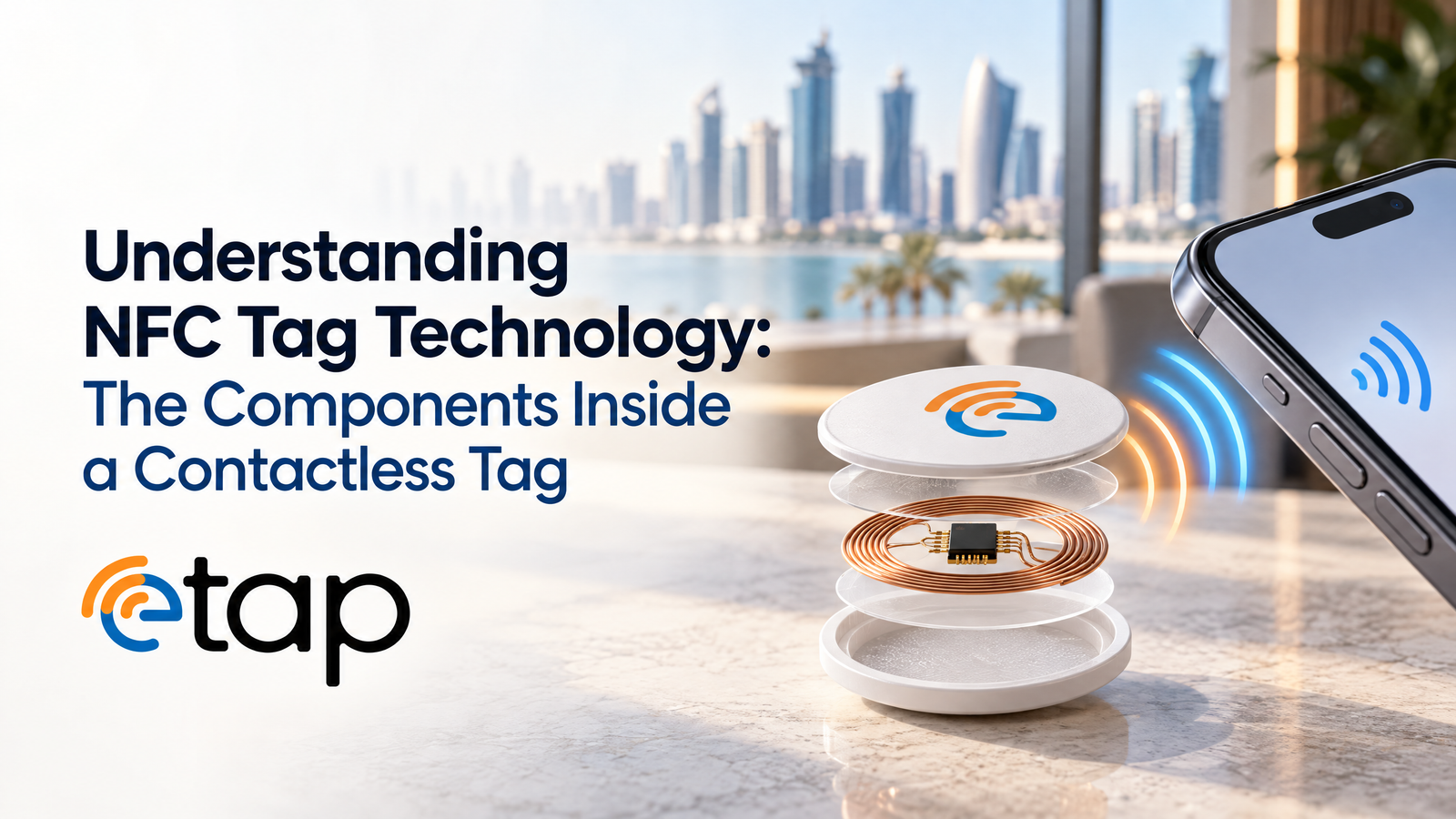
A typical passive NFC tag combines an integrated circuit, an antenna, and a supporting substrate. The integrated circuit manages communication and stores data. The antenna receives energy from the nearby reader and enables the exchange of information. The substrate holds the components in place and may be made from paper, PET film, PVC, or another suitable material. A finished product may also include adhesive, printed artwork, and a protective layer.
Understanding the Technology
NFC is a short-range communication technology commonly operating at 13.56 MHz. A passive NFC tag generally contains an integrated circuit and antenna. When a compatible phone approaches, the phone’s field powers the tag and allows it to return stored information, often a web link. RFID is a broader family of radio-frequency identification technologies. Different RFID systems use different frequencies, chips, protocols, and security approaches. Therefore, NFC and RFID should not be treated as interchangeable labels.
Memory and NDEF Records
Many everyday NFC applications use NDEF, a standard format for organizing data such as a URL or text record. A tag programmed with a website address can prompt a compatible phone to open that page. Chip models differ in memory capacity, supported functions, and security features. A short URL generally requires less memory than a longer text record, so the tag should be selected according to the information it needs to store.
Practical Business Applications
A business can use contactless products in several ways. An NFC card may share a digital business profile, while an NFC sticker can open a menu, product page, or feedback destination. RFID cards may be used with compatible identification or access-control systems. A printed employee ID card can display a person’s name, photograph, role, and company branding. A custom display can combine a printed message with a QR code or NFC interaction. The right solution depends on the customer journey and the system already in place.
Planning the User Experience
Start by deciding what the user should be able to do. If the goal is to share contact information, make the digital profile clear and easy to navigate. If the goal is to provide a menu, link directly to the menu rather than a general homepage. If the card is for access control, confirm the reader and credential requirements with the system administrator. Clear instructions, mobile-friendly pages, readable design, and testing in the actual environment all contribute to a reliable experience.
Compatibility, Security and Maintenance
Appearance alone cannot confirm whether a card will work with a reader. Check the chip type, frequency, protocol, memory, and system requirements before ordering. Simple tags that contain public URLs are not secure identity credentials. Secure access cards may use authentication and cryptographic protections, and should be issued through an authorized system. Keep links current, deactivate lost credentials where applicable, and assign responsibility for replacing damaged or outdated products.
Choosing a Supplier in Qatar
When comparing suppliers, ask for clear specifications, customization options, samples, and guidance on compatibility. Confirm whether the product is a simple NFC tag, an NFC business card, an RFID card, or a printed employee ID card with electronic functionality. For large orders, approve a proof and test samples before production. A supplier should understand both the physical product and the intended application, rather than recommending a card based only on its appearance.
Conclusion
Contactless technology is most effective when it solves a specific problem. By matching the product to the application, confirming compatibility, and maintaining the digital or access system behind it, businesses can create practical experiences for employees and customers. Careful planning helps avoid unnecessary costs and ensures that the finished product works as expected.
How Tags Are Programmed
A blank tag can be programmed using compatible NFC writing software or a supported smartphone. The user selects the data to write, places the phone close to the tag, and follows the application’s instructions. After writing, the tag should be read again to confirm that the correct information was saved. Some tags can be rewritten, while others can be locked to prevent future changes. Locking should only be done after careful testing because it may be permanent.
Limits and Responsible Use
- A standard NFC tag is not a secure vault for passwords, payment details, or confidential records. It is usually better to store a link to a properly protected website than to place sensitive information directly on the chip. For secure identity or access applications, use a credential designed for that purpose and follow the system provider’s provisioning process.
Related etap resources: etap guide to NFC tag components | etap guide to NFC cards | custom NFC solutions from etap